
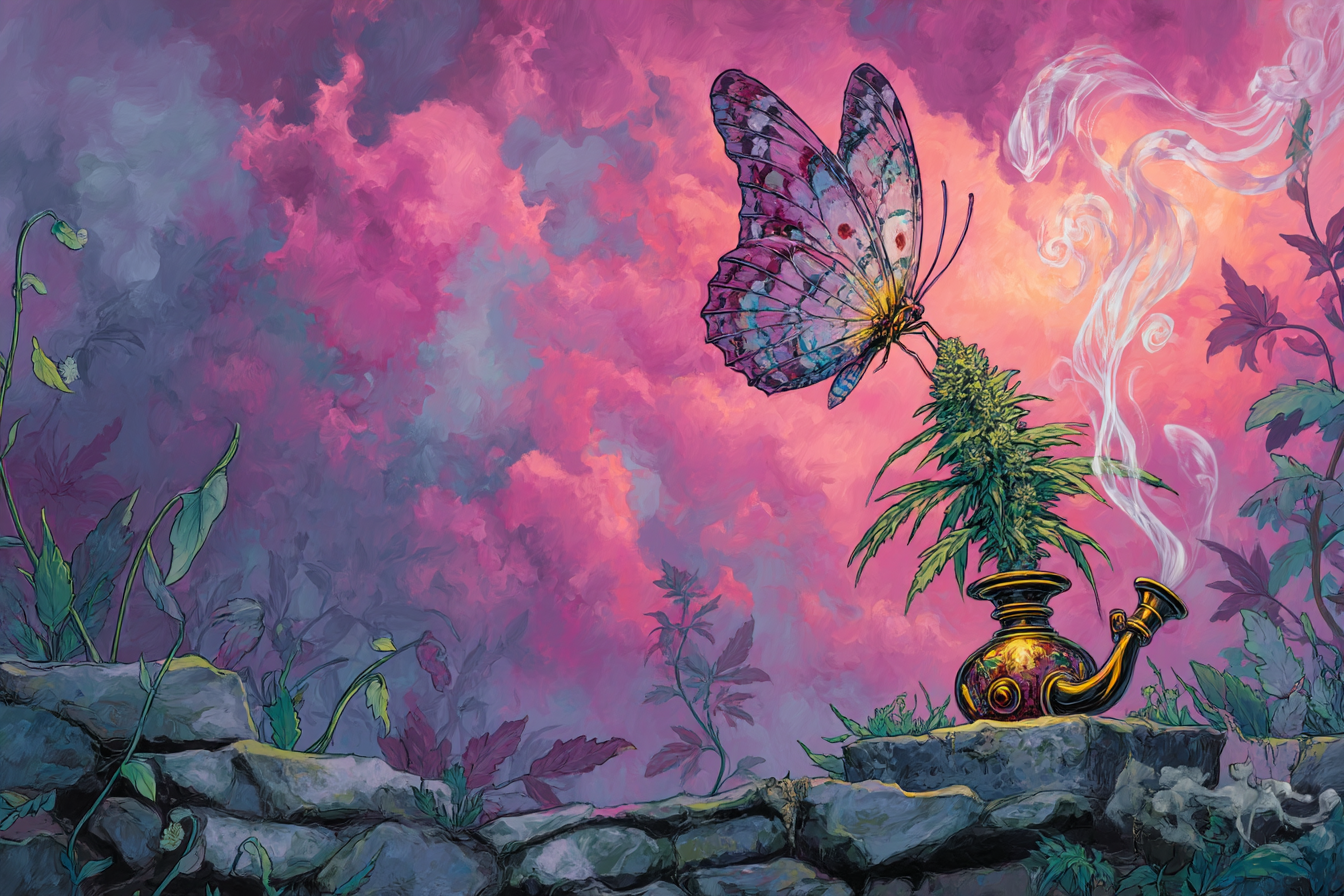
The Emerald Triangle's most mysterious indica — and the grandmother of California's modern exotic market
Overview
Purple Urkle is one of California cannabis culture's most enduring legends. Born in the Emerald Triangle — the remote, forested region of Northern California that has been the heartland of American cannabis cultivation for over half a century — this deeply indica-dominant hybrid has been putting consumers to sleep, relieving pain, and sparking joy since the 1980s. Its origins remain genuinely mysterious, its genetics debated, and its name the subject of colourful speculation. But its effects? Those are unmistakable.
Described by generations of users as a "two-hitter quitter" — a strain so potent that two hits deliver the full experience — Purple Urkle occupies a unique place in cannabis history. It is not merely a popular indica. According to cannabis historians and longtime Northern California cultivators, Purple Urkle was the first "takeover" strain in the region: the genetic foundation from which an entire lineage of modern exotics emerged, including Zkittlez, Gelato, Grape Ape, Granddaddy Purple, and Runtz. The modern exotic cannabis market, with its emphasis on complex fruity flavours and vivid colours, traces a direct line back to this mysterious purple plant from the 1980s.
"Purple Urkle gained popularity in Northern California in the late 90s and early 2000s. It was the first 'takeover' strain in the region and the origin of most modern 'exotics' that dominate today's market — such as Zkittlez, Gelato, and Runtz." — AllBud user review, longtime cultivator
The Mystery of the Name
Purple Urkle's name is as distinctive as the strain itself, and its origin is — appropriately — as debated as its genetics. The most widely circulated theory connects the name to Steve Urkel, the nerdy, suspender-wearing character from the 1990s American sitcom Family Matters. The reasoning goes that the strain's deeply calming, sedative effects produce the kind of mellow, good-natured serenity associated with Urkel's gentle disposition — and the purple colouration sealed the connection. The deliberate misspelling of "Urkle" differentiates it as a cannabis variety rather than a direct reference to the character.
Whether or not the sitcom theory is accurate, the name has stuck for over four decades. It is now one of the most recognisable strain names in the world — immediately evocative of deep relaxation, purple buds, and a grape-forward flavour profile that has made it a permanent fixture on premium dispensary menus from California to Canada.
Lineage & Mysterious Origins
Purple Urkle's genetic heritage is genuinely unknown — a rarity in the modern cannabis world where most strains have documented lineages. What is established is that it first appeared in Northern California's Emerald Triangle in the 1980s, emerging from the clandestine outdoor cultivation culture that defined that era. Beyond that, the trail goes cold.
The two most credible theories place Purple Urkle as either a select phenotype of Mendocino Purps — a storied Northern California variety known for its grape aroma, purple colouration, and potent indica effects — or as a cross between Mendocino Purps and Granddaddy Purple. Given that Granddaddy Purple itself may post-date Purple Urkle's appearance (GDP was formally introduced by Ken Estes in 2003), the Mendocino Purps phenotype theory is generally considered more historically plausible.
🍇 Purple Urkle's Famous Offspring
Purple Urkle's genetic fingerprint runs through some of the most celebrated strains of the modern era. Its distinctive grape-berry-skunk terpene profile and deep purple phenotype expression became the genetic template for California's entire "exotic" strain movement:
Zkittlez — One of the defining exotics of the 2010s; Purple Urkle × Grape Ape cross.
Gelato — Sunset Sherbet × Thin Mint GSC, with Purple Urkle in the Sunset Sherbet lineage.
Grape Ape — Direct Purple Urkle descendant; defined the "grape" cannabis flavour category.
Granddaddy Purple — Big Bud × Purple Urkle; Ken Estes's landmark 2003 creation.
Runtz — Zkittlez × Gelato; traces Purple Urkle through both parent lines.
Lavender — Early Purple Urkle hybrid; widely distributed in the early 2000s.
Hardball, Princess Purple, Purple Nepal — Direct early hybrids sharing Urkle's signature aroma.
Aroma, Flavor & Appearance
Purple Urkle's sensory profile is one of the most distinctive in cannabis. The aroma is immediately identifiable and unforgettable: a bold, layered complexity that begins with skunky earthiness at a distance and transforms into an intoxicating blend of sweet grape, ripe berry, tropical mango sap, purple flowers, and hash-spice as you move closer. The duality of the scent — skunky from afar, luxuriously sweet up close — is a characteristic that Urkle's many descendants have inherited and amplified.
On the palate, the experience is rich, coating, and persistent. The smoke is sweet and fruity with a grape-dominant foreground, backed by berry and tropical notes and finished with a deep, dank earthiness and a hint of hash or incense. Longtime users note that the flavour coats the palate and lingers in the throat long after the exhale — a hallmark of high-quality Purple Urkle that distinguishes authentic specimens from lesser imitations.
Visually, Purple Urkle is a showpiece. The buds are dense, compact, and heavily frosted with trichomes that give them an almost crystalline shimmer. The colouration is the defining feature: vivid shades of deep purple and violet, produced by anthocyanins that are activated by cold temperatures during the late flowering stage. Red-orange pistils thread through the purple and green, creating a visual contrast that is both striking and immediately recognisable.
Terpene Profile
Purple Urkle's terpene profile is anchored by Myrcene as the dominant compound — consistent with its deeply sedative, indica-dominant character. The combination of myrcene with α-pinene and humulene creates a profile that is simultaneously relaxing and physically grounding, with the pinene contributing a counterbalancing mental freshness that prevents the experience from becoming completely flat.
The myrcene-α-pinene combination is particularly noteworthy. Research suggests α-pinene may partially counteract the short-term memory impairment associated with THC, and its mild stimulatory quality prevents the myrcene-driven body stone from becoming completely sedating for experienced users at moderate doses. At higher doses, however, myrcene dominates entirely — which is why Purple Urkle reliably induces sleep in most users who consume more than a small amount.
Effects & Experience
Purple Urkle's effects are swift, powerful, and unmistakably indica in character. The onset arrives within minutes — beginning with a gentle numbing of physical discomfort and tension, followed by a warm, tingling body sensation that spreads from head to toe. Simultaneously, mood lifts noticeably: a pleasant euphoria and emotional warmth settle in, replacing stress and anxiety with a contented, happy calm.
This is the "two-hitter quitter" at work. The experience builds quickly and reaches its peak within 20–30 minutes. At this point, heavy eye pressure, full-body relaxation, and significant drowsiness are the dominant sensations. Most users find Purple Urkle best consumed approximately 30–60 minutes before the intended bedtime, allowing the initial euphoric phase to pass and the deep sedative body stone to carry them into sleep.
Positive Effects
Potential Side Effects
Best Case Usage
| Use Case | Why It Works |
|---|---|
| Insomnia | Purple Urkle's primary therapeutic application. The high-myrcene, indica-dominant profile produces reliable sedation that most users describe as among the most effective natural sleep aids available. Best taken 30–60 minutes before bed. |
| Chronic Pain | The combination of high THC, caryophyllene's CB2 activity, and the full-body myrcene stone creates broad-spectrum pain relief. Particularly effective for musculoskeletal pain, arthritis, and neuropathic conditions. |
| Muscle Spasms | The deep physical relaxation systematically releases muscle tension throughout the body. Cited by users with MS, fibromyalgia, and general muscle spasm disorders as highly effective. |
| Anxiety & Stress | The rapid mood elevation and physical tension release make Purple Urkle one of the most effective evening anxiety remedies. Note: high doses may trigger paranoia in anxious individuals — moderate dosing is key. |
| Migraines | Multiple user reports and the strain's anti-inflammatory terpene profile support its effectiveness for migraine relief. The pain-numbing onset can interrupt migraine progression effectively. |
| Nausea | The initial euphoric-relaxation phase relieves nausea effectively, making Purple Urkle useful for chemotherapy patients, those with gastrointestinal conditions, and medication-induced nausea. |
| PTSD | The combination of mood elevation, anxiety relief, and sleep induction addresses multiple PTSD symptom clusters simultaneously. Evening use prevents nighttime hypervigilance and supports sleep maintenance. |
| Depression (evening) | The warm euphoria and emotional contentment of the initial high provide genuine mood relief. Best suited to evening depression management given the sedative endpoint. |
| Appetite Stimulation | Despite humulene's appetite-suppressing properties, the overall THC effect reliably stimulates appetite. Useful for patients with eating disorders, chemotherapy-related appetite loss, and wasting conditions. |
| End-of-Day Decompression | For recreational users, Purple Urkle is the definitive "work is done" strain — an evening companion that signals the transition from activity to rest with clarity and pleasure. |
Growing Guide
Purple Urkle is a rewarding but patience-testing grow. Its most notable characteristic as a cultivar is its exceptionally long flowering time — up to five months (approximately 20 weeks) in some phenotypes, making it one of the longest-flowering commercially cultivated strains available. This is unusual for an indica-dominant strain and requires growers to plan accordingly.
The extended flowering period, while demanding, serves a purpose: the additional weeks in late flower allow the terpene profile to fully develop and the anthocyanins responsible for the purple colouration to express fully. Growers who harvest early may find buds that lack the characteristic grape intensity and visual drama that define a true Purple Urkle.
To maximise the purple colouration, experienced growers drop nighttime temperatures to 15–18°C (59–64°F) during the final two to three weeks of flowering. This cold shock activates anthocyanin production, transforming green buds into the deep violet specimens that made this strain famous. The effect is purely aesthetic — the terpene and cannabinoid profile is not materially affected by temperature manipulation — but for dispensary presentation and photography, the visual result is extraordinary.
Sources & Further Reading
- Leafly — Purple Urkle Strain Information & Reviews
- Leafwell — Purple Urkle: Effects, THC & Medical Profile
- Hey Abby — Purple Urkle Strain Review
- Hytiva — Purple Urkle Indica Cannabis Review
- DNA Genetics — Purple Urkle Cannabis Strain Profile
- CannaConnection — Purple Urkle Strain Information
- Hyperwolf — Purple Urkle: Effects, Flavors & Growing Guide
- AllBud — Purple Urkle Marijuana Strain Reviews
- MMJExpress — History Behind the Iconic Purple Urkle Strain